Introduction
Heat equipment often requires extensive amounts of heat to be transferred within a small area. One option is to increase the area by using special devices called fins. Fin tubes can be used to produce heat exchanger equipment with enhanced parameters due to the additional surface. A fin tube heat exchanger can have diversified configurations depending on the application. At the same time, an understanding of the principles and areas of application of finned tubes is critical for selecting the appropriate tube configuration.
What Are Fin Tubes?
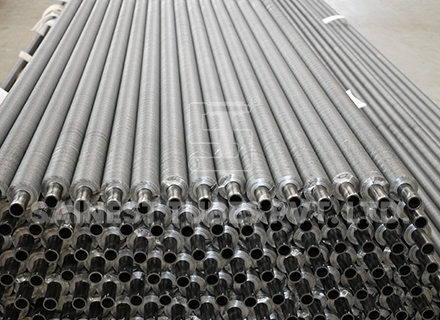
A fin tube is a structural element consisting of a tube with attached fins on the working surface.
The main purpose of the fins is to provide additional heat exchange with the working fluid. The finned tube allows the achievement of the maximum performance of the heat exchanger within the framework of the specified dimensions.
How Do Finned Tubes Improve Heat Transfer?
Heat transfer depends on many factors, among which are the temperature difference between the fluids, physical characteristics, flow regime, material, and heat transfer area. Attaching fins to the surface of the tube increases the area through which heat transfer occurs, which enhances performance. The addition of fins makes it possible to compensate for the low heat transfer coefficient of the fluid flowing over the finned surface. Thus, this technology allows for improving heat dissipation and absorption from the fluid with a given flow rate.
Main Components of a Finned Tube
A finned tube consists of two main components:
The Base Tube
The base tube provides for the flow of fluid under pressure. The mechanical properties and material of the tube must meet the requirements of the intended application.
Fins
Fins are attached to the base tube to expand its surface area. These elements differ in shape, size, material, and method of attachment. In addition, the choice of fin geometry depends on the design of the heat exchanger.
Types of Fin Tubes
Depending on the required type of heat transfer and technical feasibility, different types of fin tubes can be used.
Longitudinal Fins
Longitudinal fins extend along the axis of the tube. Devices with such a design can be used in cases where the flow of the fluid to be heated or cooled is directed along the fins.
Helical or Spiral Fins
The fins are arranged in a spiral shape around the tube. This design combines the high surface efficiency of longitudinal fins with the possibility of installation in limited space.
Other Application-Specific Designs
The geometry of the fins can vary significantly depending on the requirements and capabilities of the manufacturer. Therefore, this type of equipment uses a variety of finned-tube configurations.
Applications of Finned Tubes
Heat transfer fin tubes are used in a wide range of industries and devices. In particular, this technology is used in:
- Heat exchangers of various designs
- Air coolers
- Economizers
- Boilers
- Process heaters
- Coolers
- Condensers
- Industrial heating and air conditioning equipment
Thus, each heat exchanger has its own configuration of a finned tube, which is selected based on the required performance and available dimensions. Finned tubes for heat exchanger applications are selected according to the equipment design, operating conditions, and required heat transfer performance.
Why Surface Area Matters
The simplest way to enhance heat transfer is to increase the surface area of the heat exchanger. On a standard tube, the surface area is limited and is equal to the outer surface of the tube. When additional areas, such as fins, are introduced, this value increases. It is especially relevant when there is a need for high performance within the framework of limited space. An increase in the surface area allows the designer to achieve the necessary efficiency without increasing the dimensions of the apparatus.
At the same time, it should be borne in mind that increasing the number of fins does not necessarily lead to higher performance. Efficiency, airflow, fouling, and material are also decisive factors that must be considered.
Material Selection
Both the base tube and the fins must be made of a material suitable for the operating conditions. In particular, carbon steel, alloy steel, or stainless steel can be used for finned tubes. The choice of material is critical for ensuring the mechanical strength, thermal conductivity, and corrosion resistance of the fin tube. At the same time, material selection must meet the requirements of applicable industry standards.
Important Selection Factors
When selecting a fin tube, it is necessary to consider the following factors:
- The material of the base tube
- The material of the fins
- Tube OD
- The thickness of the tube wall
- Fin height
- Fin thickness
- Fin spacing
- Tube length
- Operating temperature
- Operating pressure
- Fluid characteristics
- Required heat transfer characteristics
- Applicable standards
The choice of a particular design of finned tubes is a complex task that takes into account many factors related to the operating conditions and performance of the heat exchanger.
Fin Tubes and Equipment Efficiency
A finned tube heat exchanger is capable of dissipating or absorbing a greater amount of heat than a standard heat exchanger under suitable operating conditions. This is due to the increased surface area of the finned tubes, the use of which allows the designer to increase efficiency within the given dimensions. Nonetheless, the performance of such equipment also depends on the flow regime, temperature difference, fouling, and other factors.
Sainest Fin Tubes
Sainest Tubes offers a range of fin tubes for industrial heat exchanger applications. The product range includes different finned-tube configurations, which can be selected based on the desired performance and geometry. Sainest Tubes offers customized solutions, taking into account the requirements for the material of the base tube and fins, as well as their dimensions. These considerations are important when selecting finned tubes for heat exchanger systems that must meet specific industrial requirements.
Conclusion
Fin tubes solve the problem of insufficient heat exchange capacity by expanding the surface area. They allow the heat exchanger designer to achieve the desired performance within the available space, thereby increasing the efficiency of the equipment. Nonetheless, the choice of finned tubes is by no means universal. It is especially important to consider the application conditions, such as the material of the base tube and operating temperatures, as well as the geometry of the fins.
By focusing on the development of specialized tubes, Sainest Tubes supports industrial requirements in the field of heat transfer. The right fin tube heat exchanger configuration depends on the intended application, operating conditions, and required performance rather than simply replacing a standard tube with a finned alternative.