Introduction
Heat exchangers allow transferring heat between fluids while keeping them physically separated. The tubes in them play a significant role, which is why their material, size, thickness, surface, and other properties must be taken into account during the equipment design. The majority of the exchangers have various configurations, and the choice of the tubing material depends on temperature, pressure, fluid characteristics, and relevant standards. This article discusses heat transfer tubes, their types, applications, and factors affecting heat exchanger performance.
What Are Heat Exchanger Tubes?
Heat exchanger tubes are tubes used in heat exchanger equipment, such as a tube heat exchanger, to enable heat transfer between fluids. In some cases they are also referred to as heat exchanger pipe.
Typically, fluids flow through them in a counterflow pattern, and the heat exchange occurs through the tube wall. In doing so, the exchanger’s performance depends on a temperature difference, fluid flows, tube material, dimensions, surface, and other factors. Therefore, selecting the appropriate tube material is essential for the exchanger design.
How Do Heat Exchanger Tubes Improve Heat Transfer?
Heat exchanger tubes enable heat transfer between fluids by providing an area through which heat would pass.
The exchanger design should ensure that the surface area, fluid flows, and pressure drops are adequate for the desired performance. The tube dimensions and material affect these characteristics directly, which is why they should be chosen carefully. It is essential to note that tubes should be selected as an integral part of the exchanger design, and not as isolated elements.
Types of Heat Exchanger Tubes
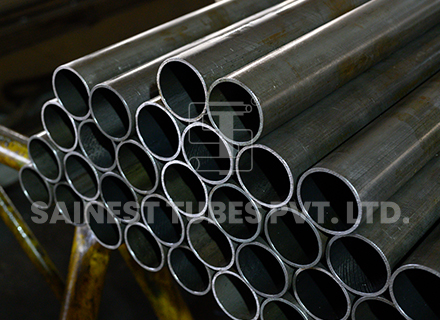
Carbon Steel Heat Exchanger Tubes
Carbon steel heat exchanger tubes are used for specific applications, where the material is suitable for the intended service.
The choice of the tube material depends on temperature, pressure, fluid characteristics, mechanical requirements, and relevant standards.
Alloy Steel Heat Exchanger Tubes
Alloy steel heat exchanger tubes are used when special properties are required.
They should have additional elements on purpose, according to the relevant standards, to improve the performance and service life under specific conditions. Similar to carbon steel, selecting an appropriate alloy steel grade should be done considering the intended application and service conditions.
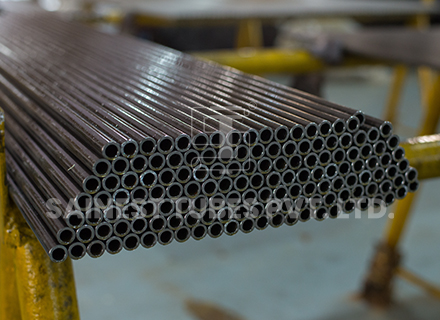
Seamless Heat Exchanger Tubes
Seamless heat exchanger tubes are produced without a weld seam. They are made using the piercing process, followed by cold drawing, heat treatment, straightening, cutting to length, and inspection. Sainest produces carbon and alloy steel seamless tubes for heat exchanger applications.
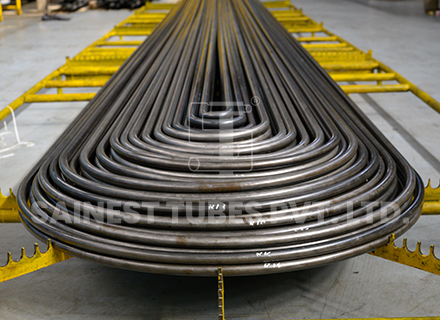
U-bend Tubes
U-bend heat exchanger tubes are bent at the end to form a U-shape. They are applied in particular cases, according to the exchanger design. Due to their configuration, U-bend tubes allow for additional space, which may be beneficial for specific configurations. The process of their manufacturing should include bending, accurate dimension control, heat treatment, and inspection in accordance with relevant standards.
Applications
Heat Exchangers
The most evident application of heat exchanger tubes is in heat exchanger equipment. Depending on the exchanger type and fluid properties, the tubes should have suitable dimensions and material.
Boilers
Boilers involve tubes as well, where heat transfer occurs between fluids. Similar to exchangers, there are various configurations, and the boiler tube material depends on temperature, pressure, and fluid characteristics.
Condensers
Condensers are another piece of equipment where tubes are essential components. They are used to enable heat transfer from fluids to another fluid to achieve condensation. Therefore, the operating conditions, fluid properties, and other factors should be taken into account.
Superheaters
Superheaters allow for raising the temperature of saturated steam beyond saturation point. Due to the high temperatures involved, material selection is essential for superheater tubes.
Coolers and Intercoolers
Coolers and intercoolers are used to remove heat from fluids. Heat exchanger tubing helps to transfer the unnecessary heat away, and its performance depends on the fluid flows, temperature difference, and other characteristics.
Factors to Consider When Selecting Heat Exchanger Tubes
Material
It is essential to select the tube material according to the operating conditions, including temperature, pressure, and fluid properties. Sainest offers carbon steel and alloy steel heat exchanger tubes. The latter ones are used in high-temperature applications, including superheaters.
Outside Diameter
The tubes’ outside diameter determines the overall dimensions of the exchanger and the surface area for heat transfer.
Wall Thickness
The wall thickness should be chosen considering the mechanical requirements, in accordance with the applicable standard.
Length
Tube length is another factor that should be considered during the equipment design, as it affects the surface area directly. Long tubes allow for increasing the area, but they also make the equipment larger. According to the Sainest specifications, the tubes can be manufactured in the desired length within the company’s capabilities.
Surface Condition
If there are any special requirements regarding the tube surface, they should be considered as well.
Standards and Testing
The choice of the tube specifications depends on the applicable standard, to which the exchanger should meet. It is essential to ensure that the tubes correspond to the standard requirements, including mechanical properties, dimensions, tolerances, and test results. This way, the equipment and tubes are compatible, which is essential for the exchanger performance.
Why Tube Selection Matters to Heat Transfer Efficiency
It is common to believe that heat exchanger performance is determined solely by its design. However, it is inaccurate, as tubes are an integral part of the exchanger, and their choice affects the performance as well. For instance, the tube diameter affects the fluid flow and surface area. In turn, a larger surface area facilitates higher heat transfer rates. At the same time, the wall thickness influences the path length of the fluid through the exchanger, as well as the mechanical characteristics of the equipment. Furthermore, the material has a major impact on the performance, as different materials have varying thermal and mechanical properties. Lastly, the tube specifications should comply with the relevant standard, which ensures that the exchanger and tubes are compatible.
Therefore, the choice of tubing should not be limited to the readily available diameters. Instead, it should consider the operating pressures and temperatures, as well as the desired mechanical performance.
Sainest Heat Exchanger Tubes
Sainest Tubes, Inc. offers carbon and alloy steel cold-drawn seamless tubes for heat exchanger applications. According to the company’s specifications, their products are suitable for various equipment, including heat exchangers, boilers, condensers, superheaters, coolers, and intercoolers. Sainest provides tubes with outside diameters from 3 mm to 177 mm in accordance with the relevant standards. Meanwhile, the walls’ thickness varies from 0.5 to 15 mm, and the length can go up to 30 meters, depending on the specifications. The company can produce the tubes according to the applicable standards and customer requirements.
Conclusion
Heat exchanger tubes are essential components of equipment designed to enable heat transfer between fluids. Their material, diameter, wall thickness, length, surface, and other properties should be chosen carefully during the exchanger design. The majority of heat exchanger tubes are made from carbon and alloy steels, but there are other materials as well. Moreover, seamless heat exchanger tubes and U-bend tubes are applied in various configurations. Thus, the choice of the heat exchanger tubing depends on the equipment design, fluid characteristics, and operating conditions. The performance of the tubes in exchangers is affected by their material, dimensions, surface, and other factors. Therefore, it is essential to consider these characteristics in accordance with the relevant standards and specifications.