Introduction
The design of a heat exchanger may involve selecting a tube that works for both its heat transfer requirements alongside any layout within the equipment. A U bend tube is suitable for such conditions; a curved configuration enables the tubing to return through the heat exchanger without having to incorporate a separate return connection. U bend tubes incorporate a range of applications; a selection of different materials, wall thickness, bending requirements, heat treatment, dimensional accuracy, and testing are all necessary aspects to consider alongside the equipment's operational conditions.
What Are U-Bend Tubes?
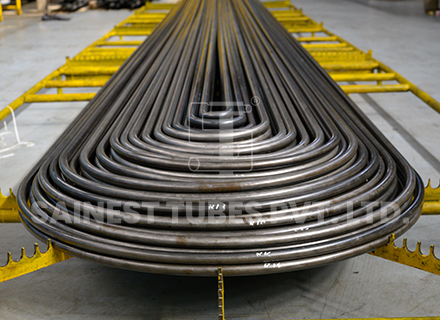
A U-bend tube is a tube that has been bent into a U-shaped configuration. The straight legs are available for connection within the heat exchanger whereas the curve enables the return of the tube.
Within a U tube heat exchanger, the tubes are positioned within its layout so that fluid can enter through one leg of the U configuration, pass through the bend and then return by the second leg.
One of the practical advantages of a U-bend is that it can be applied in configurations where the heat exchanger must accommodate the effects of thermal expansion or compact arrangements are advantageous.
Why Are U-Bend Used in Heat Exchangers?
One of the primary benefits of a U bend heat exchanger tube is its ability to accommodate thermal expansion.
When a heat exchanger is in operation under elevated temperatures, the tubes will expand. A U shaped tube has the ability to flex along its bend, accommodating thermal expansion without requiring the U tube to be fixed at either end.
This is particularly advantageous in the design of a heat exchanger where there are temperature differences between the tubing and other components.
Benefits of U-Bend Tubes
1. Accommodation of Thermal Expansion
The bend of the U-tube provides the required flexibility within the tube layout.
This can be beneficial in applications where the operating temperature will cause the tubing to expand.
2. Compact Configuration
A U bend enables the tubing to be returned within the exchanger's layout at the location of the bend.
This can accommodate compact arrangements within the heat exchanger and eliminates the need for a separate return piping arrangement.
3. Elimination of Additional Connections
A U-bend configuration can provide the return tubing at the location of the bend.
This can be advantageous compared to a straight tube arrangement where connections are required at both ends of the tubing.
4. Versatility of Application
A seamless U bend tube can be manufactured from different materials, dimensions (lengths, diameters), bend radii, and configuration according to the requirements of the application.
The selection of a U bend tube can be made according to the service conditions that it will experience within the heat exchanger.
Where Are U-Bend Tubes Used?
U bend tubes for heat exchanger applications can be found across a range of process industries.
They can be found in:
- Heat exchangers
- Boilers
- Condensers
- Process cooling systems
- Oil and petrochemical equipment
- Power-generation equipment
- Industrial process systems
The suitability of a U bend tube is dependent upon the material that it is manufactured from, the dimensions, and the applicable specification.
Material Selection
The material selection is one of the first considerations when selecting a U bend tube.
Carbon steel and alloy steel can be used where appropriate.
The grade of the material must meet the requirement of the chemical composition and mechanical properties while being compatible with the operating temperature, pressure, and service conditions.
The material grade should be selected according to the requirements of the equipment specification rather than opting for the most readily available option.
Wall Thickness and Dimensions
The dimensions of the tube must be established prior to its manufacture.
Key parameters include:
- Outside diameter
- Wall thickness
- Straight length
- Overall dimensions of the U-bend
- Radius of the bend
- Leg length
- Required tolerances
The bending process must be carried out in a manner that maintains the integrity of the tube while meeting the dimensional requirements.
What Happens During Bending?
The bending process is an important aspect of manufacture since it ensures that the tube can achieve the required configuration while maintaining the integrity of the tube.
The process will be carried out according to the properties of the material, the diameter and wall thickness of the tube, the radius of the bend, and the requirements of the customer.
Once the bending process is complete, suitable inspection and testing can be carried out according to the requirements of the specification or customer request.
Heat Treatment and Testing
Depending upon the requirements of the specification, heat treatment may be undertaken to treat the U bend tube.
Testing can include dimensional checks, hydrostatic testing, non-destructive testing, and other tests according to the requirements of the customer or applicable standard.
The exact requirements of the testing and heat treatment will depend upon the application and specification.
How to Select U-Bend Heat Exchanger Tubes
The buyer should provide as much technical information as possible prior to requesting a quotation for the purchase of a U bend tube.
This can include:
- Material grade
- Tube OD
- Wall thickness
- Length of tube
- Bend radius
- Dimensions of U bend
- Heat treatment
- Testing requirements
- Applicable standard
- Quantity
- Application conditions
The provision of specification ensures that the manufacturer can fully understand the requirements of the tube.
When sourcing U bend heat exchanger tubes, buyers should confirm that the selected manufacturer can meet the specified material, dimensional, bending, heat treatment, and testing requirements.
Sainest U-Bend Tubes
Sainest Tubes is able to manufacture U bend tubes for heat exchanger applications according to the requirements of the customer. The company's information on U bend tubes makes references to applications in heat exchangers, boilers, condensers, and related industrial equipment. The company indicates that its U bend tubes can be manufactured to TEMA Class 3 RCB or customer requirements, with heat treatment and testing being carried out according to the specified requirements.
For industrial buyers sourcing U bend tubes, aligning the product with the intended application and technical specification remains an important part of the selection process.
Conclusion
U bend tubes for heat exchanger applications have the ability to combine the requirements of a tube for its heat transfer application along with the requirement for a bend. Their ability to accommodate thermal expansion and provide a functional return path makes them suitable across a range of configurations for heat exchanger applications. However, the selection of the most appropriate U bend tube requires the buyer to consider the requirements of the application in terms of its material, dimensions, wall thickness, bend radius, heat treatment, testing, and the operational conditions of the equipment.
At Sainest Tubes, the manufacture of U bend tubes considers the requirements of the application and specification to ensure that the customer receives a tube configured to meet the demands of the heat exchanger system.